


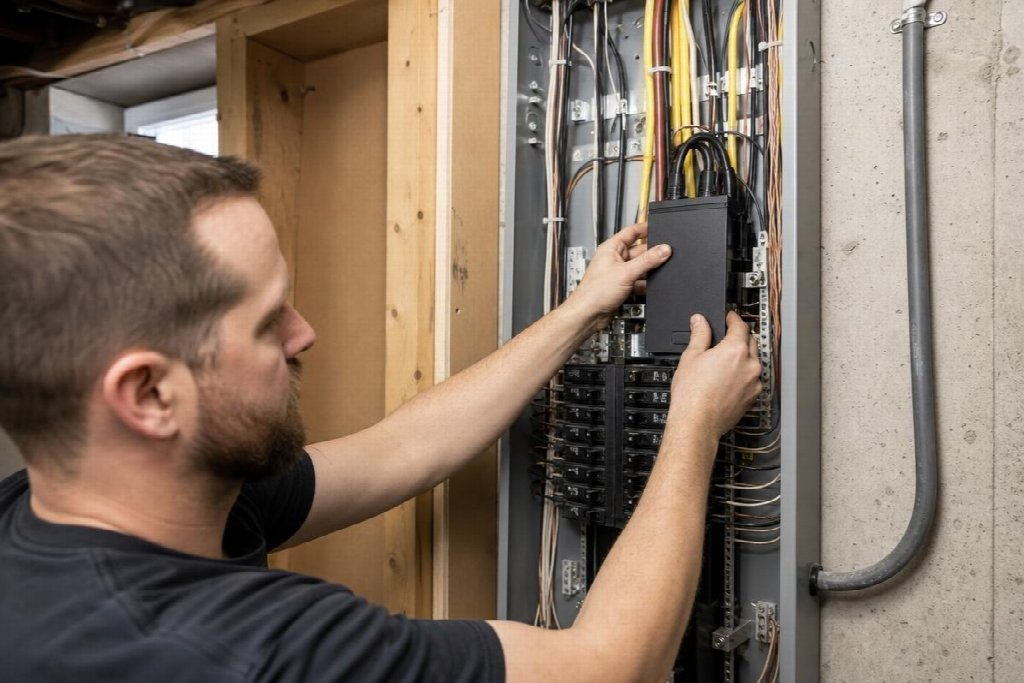
A power surge can wipe out thousands of dollars in appliances and electronics in a fraction of a second. For Grand Rapids homeowners, that risk is real year-round—from summer lightning storms to everyday voltage fluctuations that quietly wear down your HVAC system, refrigerator, and smart devices. Grapids Home Services has been helping West Michigan families protect their homes since 1999, earning a BBB A+ rating along the way. This article covers five reasons a panel-level surge protector belongs in every Grand Rapids home.
Why Grand Rapids Homeowners Should Think About Surge Protection
Most homeowners assume a power strip with a built-in surge protector is enough—but that leaves a significant gap in electrical protection.
West Michigan sits in a Great Lakes climate corridor. Spring and summer thunderstorms roll through Kentwood, Wyoming, and Grandville regularly, and late-season ice storms add grid stress in winter. Consumers Energy and other local utilities experience switching events and storm-related voltage spikes that hit entire neighborhoods at once.
A panel-level surge protective device (SPD) mounts directly at the main electrical panel and intercepts voltage spikes before they travel through branch circuits. A plug-in power strip only protects devices plugged into that one strip—it offers zero defense for hardwired appliances like a furnace, central AC, or water heater.
Reason 1: Michigan Thunderstorms Send Voltage Spikes Straight to Your Panel
Lightning does not have to strike a house directly to destroy appliances. A nearby strike on a utility line injects a massive voltage spike into the distribution system, which travels straight to the panel and fans out through every circuit in the home.
Storm cells tracking east across Lake Michigan can intensify before reaching the metro area. Utility switching events on high-demand summer afternoons add further grid instability—with no lightning involved at all.
Type 1 vs. Type 2: Which Device Does What?
- Type 1 SPD: Installed ahead of the main breaker. Handles large external surges, including direct lightning strikes on the service entrance. Required when a home has a lightning protection system.
- Type 2 SPD: Installed at or after the main panel. The standard residential choice. Catches both external grid surges and surges generated inside the home.
Most homes in the Kentwood, Wyoming, and Caledonia areas are well served by a Type 2 device, which clamps voltage spikes at the panel before they reach individual outlets and appliances.
Which Appliances Are Most at Risk?
Modern homes carry far more risk than older ones because today’s equipment runs on microprocessors rather than simple motors. A single surge event can destroy any of these:
- Furnace control boards and variable-speed blower motors
- Variable-speed AC compressors and smart thermostats
- Electronic water heater controls
- Refrigerators, dishwashers, and washer/dryer units with digital displays
- Home theater equipment, computers, and smart home hubs
A furnace control board alone can cost several hundred dollars to replace before labor. A panel-level device protects all of it at once, for a fraction of that cost. For homes with aging panels, Grapids Home Services’ circuit breaker repair team can assess whether the panel is ready to support a surge protective device before installation.
What to Look for When Choosing a Whole-House Surge Protector
Not all panel-level surge protectors are built the same. Three specs and one key classification separate a quality unit from a cheap one.
Type 1 vs. Type 2 Surge Protective Devices
A Type 1 device installs before the main breaker and absorbs large external surges, including nearby lightning strikes. Most utility providers, including Consumers Energy, require coordination before installation. These are less common in standard West Michigan residential installs.
A Type 2 device installs at or after the main panel and handles both incoming grid surges and internal surges generated when motors cycle on and off. For most homeowners in the Caledonia, Lowell, and Rockford areas, a Type 2 is the right starting point. Homes built before the 1990s may need a grounding assessment or a combination Type 1 and Type 2 device.
Key Specs: Clamping Voltage, Joule Rating, and Response Time
- Clamping voltage. The threshold at which the device activates and diverts surge energy. Lower is better. Per UL 1449 standards, 400 volts or below is the residential target.
- Joule rating. The total surge energy the device can absorb over its service life. Residential panel units typically range from 1,000 to 4,000 or more joules. A higher rating means longer service under repeated surge conditions.
- Response time. A quality panel SPD should respond in one nanosecond or faster. Anything slower risks letting energy reach sensitive equipment before the device engages.
For homeowners researching electrical protection in the Grand Rapids area, Grapids Home Services’ circuit breaker repair page covers related panel health topics worth reviewing alongside surge protection decisions.
Reason 2: Internal Surges Happen Every Day Inside Your Own Home
Most homeowners assume surge protection is only about lightning. It is not. The larger ongoing threat for most West Michigan homes is the slow, invisible damage caused by surges that originate inside the house itself.
Every time a large motor starts or stops—a central AC compressor, a furnace blower, a refrigerator, a sump pump—it generates a small voltage spike that travels back through your home’s wiring. These internal surges are far smaller than a lightning event, but they happen dozens of times a day. Over months and years, that repeated stress degrades the microprocessors and control boards inside your appliances, shortening their effective service life well before a single dramatic failure ever occurs.
A panel-level Type 2 surge protective device catches these internal spikes at the source before they can distribute through branch circuits. For homes in Grandville and Wyoming where older panels may already be cycling large motors near their limits, this protection adds up quickly.
Reason 3: Today’s Smart Appliances and HVAC Equipment Have No Tolerance for Voltage Spikes
Appliances built 30 years ago ran on simple motors and relays. A surge might trip a breaker and leave the equipment intact. Today’s equipment is fundamentally different. Smart thermostats, variable-speed HVAC compressors, electronic water heater controls, and connected appliances all rely on embedded microprocessors that have essentially zero tolerance for voltage irregularities.
A single surge event that a 1970s refrigerator would have absorbed without issue can destroy a modern appliance control board in a fraction of a second. The cost difference matters. Replacing a basic motor component might run a few hundred dollars. Replacing a variable-speed furnace control board, or the furnace itself, can run well into four figures before labor is factored in. Homes in newer subdivisions in Caledonia and Ada are full of exactly this kind of equipment.
Grapids Home Services’ circuit breaker repair team sees this pattern regularly: homeowners who invested in high-efficiency, connected systems without adding panel-level protection to match. A whole-house surge protector is the missing piece that makes that investment defensible.
Reason 4: Plug-In Power Strips Leave Your Most Expensive Systems Completely Exposed
A power strip with a built-in surge protector protects the devices plugged into it, and nothing else. Your furnace, central air conditioner, water heater, sump pump, and refrigerator are hardwired directly into your panel. No power strip ever touches them. During a surge event, those systems absorb the full spike with nothing in between.
In West Michigan, those hardwired systems represent most of the high-value equipment in your home. A furnace control board alone can cost several hundred dollars to replace before labor—and that assumes the board is still available and the rest of the system is intact. A whole-house surge protective device at the panel is the only way to extend protection to hardwired systems that plug-in strips can never reach.
This is the most common gap Grapids Home Services identifies when homeowners ask about surge protection. The strip protecting your television is doing its job. Your HVAC system is sitting completely unprotected on the other side of your panel.
Reason 5: The Cost of Protection Is a Small Fraction of What You Are Protecting
The math on whole-house surge protection is straightforward. A professionally installed panel-level surge protector typically costs far less than replacing a single major appliance. Compare that to the combined replacement cost of a furnace control board, a refrigerator, and a smart thermostat, and the calculation tilts quickly in favor of protection.
For Grand Rapids homeowners who recently upgraded to a high-efficiency variable-speed furnace, a smart HVAC system, or a tankless water heater, a whole-house surge protector is simply risk management. Thousands of dollars went into equipment designed to run efficiently for 15 to 20 years. A panel-level device protects that investment for a fraction of what was spent.
Grapids Home Services offers free estimates for surge protector installation, so homeowners can get an accurate number before committing to any work. For homes in Heritage Hill, Eastown, and other older neighborhoods where the panel may need assessment or grounding work first, the estimate covers what it takes to get the system ready.
Frequently Asked Questions
How much does a whole-house surge protector cost to install?
Installation cost depends on the type of device, the condition of the electrical panel, and whether any grounding upgrades are needed. A licensed electrician can provide an accurate quote after inspecting the panel, since older homes in areas like Heritage Hill sometimes require additional grounding work before installation.
Will a whole-house surge protector stop damage from a direct lightning strike?
A panel-level surge protector significantly reduces the risk of damage from nearby lightning strikes and grid-related voltage spikes, but a direct strike on the home itself can carry more energy than any SPD is rated to handle. Homes with a dedicated lightning protection system typically pair it with a Type 1 device for added coverage.
Can I install a whole-house surge protector myself?
No. A panel-level surge protector connects directly to the main electrical panel, which carries a serious safety risk without proper training. Installation should always be handled by a licensed electrician who can confirm the panel can safely support the device.
How long does a whole-house surge protector last?
Most panel-level devices are rated for years of service, but their lifespan depends on how many surge events they absorb. Frequent storms or grid switching events, common in storm-heavy seasons across Wyoming and Grandville, can shorten the device’s effective life. Many units include an indicator light that signals when the device needs replacement.
Do I still need power strip surge protectors if I install a whole-house unit?
Yes. A whole-house surge protector handles large-scale surges from the grid or nearby lightning, while plug-in power strips still provide an extra layer of protection for sensitive electronics like computers and home theater equipment. Using both gives layered protection rather than relying on a single point of defense.
How do I know if my home’s electrical panel can support a surge protector?
Panel age, available breaker space, and grounding all factor into whether a panel is ready for an SPD. A licensed electrician can assess the panel during an inspection, and any necessary upgrades, such as those handled by Grapids Home Services’ circuit breaker repair team, should be completed before the surge protector is installed.
Is a whole-house surge protector covered by homeowners insurance?
Some homeowners insurance policies offer discounts or coverage incentives for installing a whole-house surge protector, since it reduces the likelihood of an expensive appliance damage claim. Coverage details vary by provider, so homeowners in Caledonia, Lowell, and Rockford should check with their insurance company directly.
About Grapids Home Services
Grapids Home Services is a licensed and insured HVAC, plumbing, and electrical company founded in 1999 by D. Nathan Engelsma, serving homeowners across the Grand Rapids area and surrounding West Michigan communities. The company holds a BBB A+ Rating, is BBB Accredited, and is HomeAdvisor Screened and Approved. Their office is located at 3325 3 Mile Road NW, Grand Rapids, MI 49534.
Business Name: Grapids Home Services
Address: 3325 3 Mile Road Northwest, Grand Rapids, MI 49534
Phone number: (616) 210-3456