

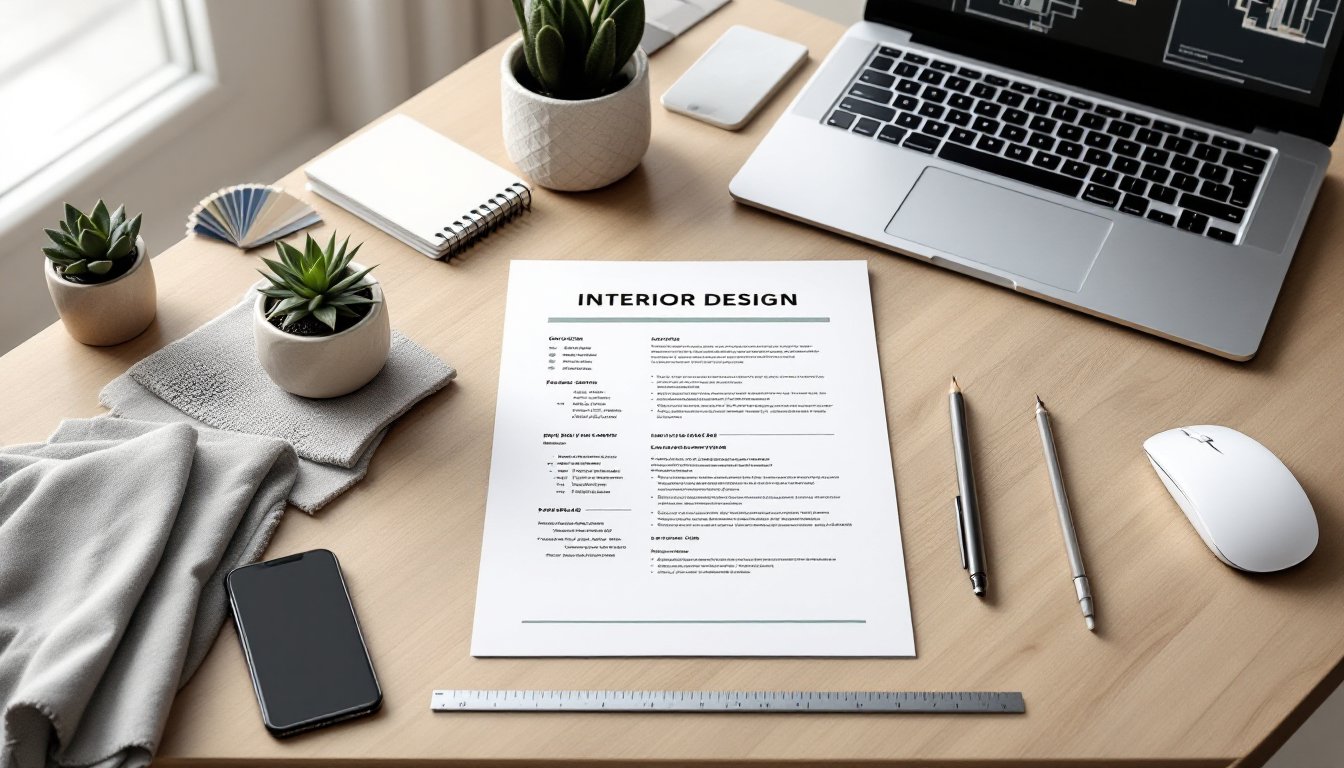
Creating a resume that opens doors in the interior design industry isn’t just about listing your education and job history. It’s about showcasing your creative vision, technical expertise, and ability to transform spaces, all on a single page or two. Unlike traditional resumes, interior design applications need to balance professional credibility with visual appeal, demonstrating both your design sense and your practical skills. Whether you’re fresh out of school or pivoting from residential to commercial work, your resume is the first design project a potential employer will see. Make it count.
Key Takeaways
- An interior design resume template must balance professional credibility with visual appeal, using clean layouts and quantifiable achievements to stand out to hiring managers who review dozens of applications.
- Include a portfolio link in your resume header and weave project highlights into experience bullets with specific details like square footage, budgets, and design challenges solved to demonstrate impact.
- Showcase relevant design software proficiency (AutoCAD, SketchUp, Revit) and technical skills like ADA compliance and construction documentation that align with the job posting’s keywords.
- Format your interior design resume as a PDF with consistent fonts, minimal accent colors, and strategic white space—avoiding overdesign, clipart, and decorative elements that confuse applicant tracking systems.
- Tailor your professional summary and competencies to the specific firm’s niche (hospitality, residential, commercial) and include credentials like NCIDQ certification or LEED accreditation prominently.
- Proofread meticulously and test all portfolio links before submitting, as errors and broken links signal carelessness in a field where precision and client presentation skills are essential.
What Makes an Interior Design Resume Stand Out
An interior design resume needs to do double duty: prove professional competence while hinting at creative talent. Hiring managers skim dozens of applications, so visual hierarchy matters just as much as content.
Clean, intentional layout separates strong candidates from the pile. Use consistent spacing, clear section breaks, and a typeface that’s readable at a glance, no script fonts or overly decorative headers. Think of it like selecting finishes for a client: restraint often beats flash.
Quantifiable achievements carry more weight than vague descriptions. Instead of “managed multiple projects,” try “coordinated five commercial buildouts totaling 12,000 square feet, delivered on time and 8% under budget.” Numbers provide context and prove impact.
Tailored content is non-negotiable. A one-size-fits-all resume won’t cut it. If you’re applying to a hospitality design firm, emphasize restaurant or hotel projects. For residential work, highlight space planning for kitchens, baths, and custom millwork. Many firms hiring through platforms like Houzz look for candidates who understand their specific market niche.
Finally, visual polish without gimmicks shows design judgment. A tasteful header, strategic use of white space, and perhaps a muted accent color demonstrate sophistication. Avoid clipart, photo backgrounds, or anything that screams “template downloaded at 2 a.m.”
Essential Sections Every Interior Design Resume Needs
Start with a professional summary, two to three sentences at the top that frame your experience and specialty. Skip the generic “passionate designer seeking opportunities.” Instead: “Licensed interior designer with six years in sustainable commercial interiors, specializing in LEED-certified office environments and adaptive reuse projects.”
List core competencies or skills in a scannable format near the top. Hiring managers and applicant tracking systems (ATS) both look for keywords here. Include design software (AutoCAD, SketchUp, Revit), technical skills (construction documentation, code compliance, FF&E procurement), and relevant specializations (universal design, hospitality, healthcare).
Your professional experience section should list jobs in reverse chronological order. For each role, include the firm name, location, your title, and dates. Bullet points should start with action verbs and focus on responsibilities and results: “Developed space plans and 3D renderings for 15+ residential remodels” or “Collaborated with architects and contractors to ensure ADA compliance on municipal projects.”
Education and credentials come next. List your degree, institution, and graduation year. If you attended an interior design trade school or completed an interior design associate degree, include it here. NCIDQ certification, state licensure, or LEED accreditation should be prominently listed, these credentials matter in competitive markets.
Portfolio Integration and Project Highlights
This is where interior design resumes diverge from corporate templates. A portfolio link is essential, usually placed in the header alongside your email and phone number. Use a custom URL if possible (yourname.com or yourname.myportfolio.com) rather than a generic Behance string.
Within your experience bullets, weave in project highlights that give context. Mention project types, square footage, budgets (if appropriate), and design challenges solved. For example: “Led kitchen and bath redesign for 1920s bungalow, sourcing period-appropriate fixtures within a $35,000 budget.”
If you lack extensive work history, consider adding a selected projects section. List three to four standout projects, academic or freelance, with brief descriptions. This works especially well for recent graduates or career changers who’ve built strong student work. Candidates creating interior design presentation boards for client pitches can adapt that same project storytelling for resume format.
Don’t embed full images in your resume PDF unless you’re certain it won’t bloat the file size or confuse ATS software. Instead, use your portfolio link and let the work speak for itself in the proper context.
Formatting Your Interior Design Resume for Maximum Impact
Length matters. For early-career designers, one page is standard. Designers with 7+ years or extensive commercial work can extend to two pages, but every line should earn its place. If you’re padding with irrelevant college clubs or high school awards, trim it.
File format should be PDF unless the application specifically requests otherwise. PDFs preserve formatting across devices and operating systems. Name the file professionally: “LastName_FirstName_InteriorDesign_Resume.pdf,” not “resume_final_v3.pdf.”
Margins and spacing should feel open but not wasteful. Standard 0.5″ to 1″ margins work for most layouts. If you’re cramming text to the edges or using 10-point type to fit everything, you’ve got too much content.
Typeface selection reveals design judgment. Stick with clean, modern sans-serifs (Helvetica, Avenir, Proxima Nova) or classic serifs (Garamond, Georgia) for body text. Mixing two fonts, one for headers, one for body, can add visual interest without chaos. Whatever you choose, ensure it’s legible at small sizes and prints clearly.
Color and graphics should enhance, not distract. A single accent color for section headers or your name can create visual interest. Avoid neon, avoid gradients, and avoid anything that wouldn’t look professional printed in grayscale. Remember: some firms still print resumes for interview panels.
Consistent formatting across all elements builds trust. If you bold company names, bold all of them. If you use bullet points in one section, use them throughout. These details signal attention to the kind of precision interior design work demands.
Skills and Software to Showcase on Your Resume
Design software proficiency is table stakes. At minimum, list AutoCAD, SketchUp, and Adobe Creative Suite (Photoshop, InDesign, Illustrator). If you’re proficient in Revit, Chief Architect, or 3ds Max, call it out, these are often required for commercial or architectural firms.
Rendering and visualization tools demonstrate your ability to communicate ideas. V-Ray, Enscape, Lumion, or even hand-rendering skills can differentiate you from candidates who rely solely on mood boards sourced from Homify.
Project management and specification software shows you understand the business side. Familiarity with Studio Designer, Ivy, or even basic Excel for budgeting and tracking can appeal to smaller firms. Procurement platforms like Material Bank or trade-specific tools add value if relevant to the job.
Technical and code knowledge matters more as you gain experience. Mention familiarity with ICC (International Code Council) standards, ADA compliance, or local building codes if applicable. For jurisdictions with strict regulations, this knowledge is a competitive advantage.
Soft skills belong here too, but be specific. “Client communication” is vague: “Conducted client presentations and design reviews for high-net-worth residential clients” is concrete. If you’ve managed contractor coordination, vendor negotiations, or interdisciplinary teamwork with architects and engineers, say so.
Avoid listing skills you can’t back up in an interview. If you opened Revit once in school, don’t claim proficiency. Firms often test software skills during interviews or trial projects.
Common Resume Mistakes Interior Designers Should Avoid
Overdesigning the resume is the most common trap. Yes, you’re a designer, but your resume isn’t a portfolio piece. Excessive colors, ornate borders, or unconventional layouts can backfire, especially with ATS software that can’t parse creative formats. If the system can’t read your resume, it won’t reach human eyes.
Generic objective statements waste space. “Seeking a position where I can grow and contribute” tells hiring managers nothing. If you include a summary, make it specific and value-driven.
Ignoring keywords from the job posting costs opportunities. Many firms use applicant tracking systems to filter resumes before a human reviews them. If the posting mentions “hospitality design,” “FF&E selection,” or “Revit,” and you have that experience, use those exact terms.
Listing duties instead of accomplishments makes your experience sound passive. “Responsible for creating floor plans” vs. “Designed space plans for 20+ residential projects, increasing client satisfaction scores by 15%.” The second version proves impact.
Neglecting proofreading is unforgivable in a detail-oriented field. Typos, inconsistent verb tenses, or formatting errors suggest carelessness. If you can’t manage consistency on your own resume, why would a firm trust you with client presentations or construction documentation?
Weak or missing portfolio links undermine your application. If your link is broken, outdated, or leads to a password-protected page, you’ve lost the chance to impress. Test your link from multiple devices before submitting.
Including irrelevant experience dilutes your message. That summer job lifeguarding in college? Probably not relevant unless you’re applying to a resort design firm and can connect it meaningfully. Focus on experience that supports your design narrative.
Conclusion
Building a resume that gets noticed in the interior design field requires balancing creativity with clarity, and personality with professionalism. Tailor every application to the role, keep formatting clean and consistent, and let your portfolio do the heavy lifting on visual flair. Whether candidates are fresh from design school programs or seasoned pros pivoting to a new specialty, a well-crafted resume opens doors, and starts conversations that lead to dream projects.