

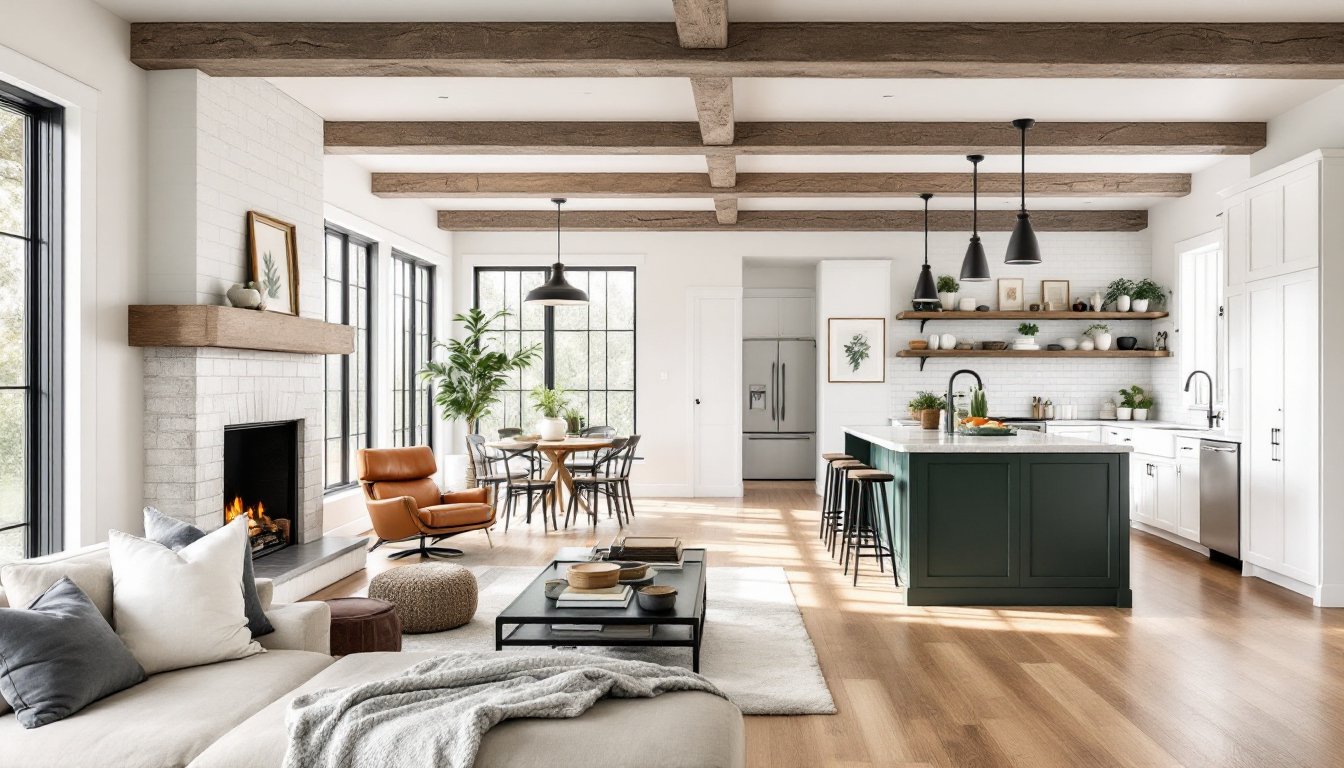
Contemporary farmhouse interiors have quietly become one of the most enduring design movements of the last decade, and 2026 is shaping up to be its most refined chapter yet. The look pairs the warmth of old barn timbers with the clean geometry of modern architecture, giving homeowners a style that feels lived-in without looking dated. This guide breaks down what makes the aesthetic work, the materials and palettes worth investing in, and the practical mistakes that turn a thoughtful design into a Pinterest cliché.
Key Takeaways
- Contemporary farmhouse interiors balance rustic textures with clean modern lines, avoiding country kitsch by using restrained design choices like black-framed windows and sparse shiplap accents.
- Material honesty is essential—invest in real wood flooring, stone countertops, and authentic metal hardware rather than veneers and faux finishes to avoid a cheap appearance.
- A contemporary farmhouse color palette relies on warm whites and soft greiges with deeper anchors in charcoal, forest green, and muted navy, tested in multiple light conditions before committing.
- Mix a minimum of three textures per room and keep metal finishes consistent to one primary tone plus one accent, preventing visual chaos and indecision.
- Avoid common mistakes like over-shiplapping every surface, using mass-market word art, applying all-gray tones, and skipping proper wall and floor preparation that reveal imperfect installation.
- Scale furniture appropriately to your room and subtract 36 inches of clearance on each side before sizing pieces, then add one unexpected antique or curated detail to inject personality without looking like a showroom.
What Defines a Contemporary Farmhouse Interior
A contemporary farmhouse interior takes the bones of a traditional rural home, exposed beams, plank flooring, simple millwork, and strips away the country kitsch. No roosters on the wallpaper. No gingham everything. Instead, the style leans into clean lines, generous natural light, and a tight material palette.
Think of it as the meeting point between two design schools: the honest craftsmanship of a 1900s farmhouse and the restraint of modern minimalism. Shiplap still has a place, but it’s used sparingly, often as an accent wall rather than wrapping every room. Black-framed windows replace fussy white grilles. Industrial-style pendants hang where a wagon-wheel chandelier might once have lived.
The defining trait is balance. Rustic textures soften the modern shell, and modern proportions keep the rustic from feeling like a theme park.
Core Design Elements and Materials to Use
Material honesty is the foundation. Surfaces should look like what they are, real wood, real stone, real metal. Veneers and faux finishes are the fastest way to make a space feel cheap.
Standard ingredients include:
- Wide-plank flooring in white oak or hickory, typically 5″ to 7″ wide, finished with a matte oil or hardwax
- Shiplap or nickel-gap paneling (nominal 1×6 or 1×8 pine, actual width closer to 5.5″ or 7.25″)
- Honed quartzite or soapstone countertops instead of high-polish granite
- Matte black hardware in iron or powder-coated steel
- Linen, wool, and cotton upholstery, skip the synthetics where possible
For a deeper look at how these elements show up in heritage homes, the principles in traditional farmhouse styling translate well into contemporary builds with minor tweaks to scale and finish.
Wood, Metal, and Mixed Textures
Mixing textures is what keeps a neutral room from going flat. A reclaimed oak mantel reads differently than a smooth painted built-in, even when both are the same color. Pairing a hot-rolled steel range hood with white plaster walls creates the same kind of visual tension.
A reliable rule: three textures per room, minimum. For example, a living room might combine rough-sawn ceiling beams, smooth lime-washed plaster, and a nubby boucle sofa. Country Living’s breakdown of authentic farmhouse materials emphasizes the same point: the look fails when everything is the same finish.
Metal accents should stay consistent in tone. Mixing brushed nickel, oil-rubbed bronze, and brass in one room reads as indecision, not eclecticism.
Choosing a Modern Farmhouse Color Palette
The palette is where contemporary farmhouse decor rustic style earns its keep. Warm whites and soft greiges form the base, with deeper anchors pulled from nature, charcoal, forest green, clay, and muted navy.
Reliable starting points:
- Walls: warm whites like Benjamin Moore White Dove or Sherwin-Williams Alabaster (both cover roughly 350–400 sq ft per gallon on primed drywall)
- Trim and cabinetry: a half-shade darker than the walls to avoid the stark contrast that dates a space
- Accents: matte black, weathered bronze, or aged brass in no more than two finishes per room
Avoid pure cool whites and gray-heavy palettes, those read as builder-grade modern, not farmhouse. The goal is warmth without yellowing. A useful exercise: borrow color logic from different design styles and notice how farmhouse leans warmer than Scandinavian and softer than industrial. Always test paint with at least two sample boards in different light conditions before committing.
Room-by-Room Styling Ideas
Farmhouse interior decor ideas hit differently depending on the room. A kitchen can take more visual weight, exposed shelves, contrasting island, statement hood, while a bedroom usually benefits from restraint.
Kitchens, Living Rooms, and Bedrooms
Kitchens are the workhorse of the style. A two-tone scheme works well: lighter perimeter cabinets paired with a darker island in forest green, navy, or charcoal. Open shelving made from 2×10 rough-sawn oak (actual thickness 1.5″) on black iron brackets gives a practical, industrial edge. Apron-front sinks remain a defining detail, just go fireclay or stainless rather than the more dated white porcelain.
Living rooms should anchor around a real focal point, usually a fireplace clad in limestone, brick, or vertical shiplap. Furniture stays low-profile with deep seats, slipcovered linen sofas pair well with leather club chairs. Skip the matched sets. Drawing from cozy, personalized spaces keeps the room from feeling staged.
Bedrooms lean quieter. A simple white oak platform bed, linen bedding in oatmeal or sage, and a single statement piece, a vintage rug or an antique dresser, do more than a roomful of accessories. For smaller footprints, the spatial logic in small modern interiors applies: scale furniture to the room, not the catalog photo. Designers at Home Bunch consistently show bedrooms where one or two heirloom pieces carry the whole space.
Common Mistakes to Avoid When Designing Your Space
Most farmhouse interior decorating ideas go sideways for the same handful of reasons. Knowing them up front saves money and rework.
- Over-shiplapping. One accent wall or a single ceiling treatment is plenty. Wrapping every room turns the house into a theme.
- Mass-market signage. “Live Laugh Love” and oversized metal word art read as dated almost immediately. Vintage finds, framed botanicals, or original art age better.
- All-gray everything. Cool grays fight the warm woods that define the style. Stick to warm neutrals.
- Mixing too many metal finishes. Pick one primary metal and one accent. Three or more looks unintentional.
- Skipping the prep. Shiplap installed over un-shimmed walls telegraphs every stud bump. Floors laid without proper 48–72 hour acclimation will cup or gap with the first humidity swing.
- Ignoring scale. A massive farm table in a small dining nook crowds the room. Measure the space, then subtract 36 inches of clearance on each side before sizing furniture.
The style also benefits from a touch of personality. Borrowing a single idea from vintage eclectic mixing, one unexpected antique, or even a curated detail from a farmhouse ideabook, keeps the space from feeling like a showroom.
Done right, a contemporary farmhouse interior reads as warm, intentional, and quietly modern, a home that looks like it was built to last, not built to trend. Start with the bones, respect the materials, and let restraint do the heavy lifting.